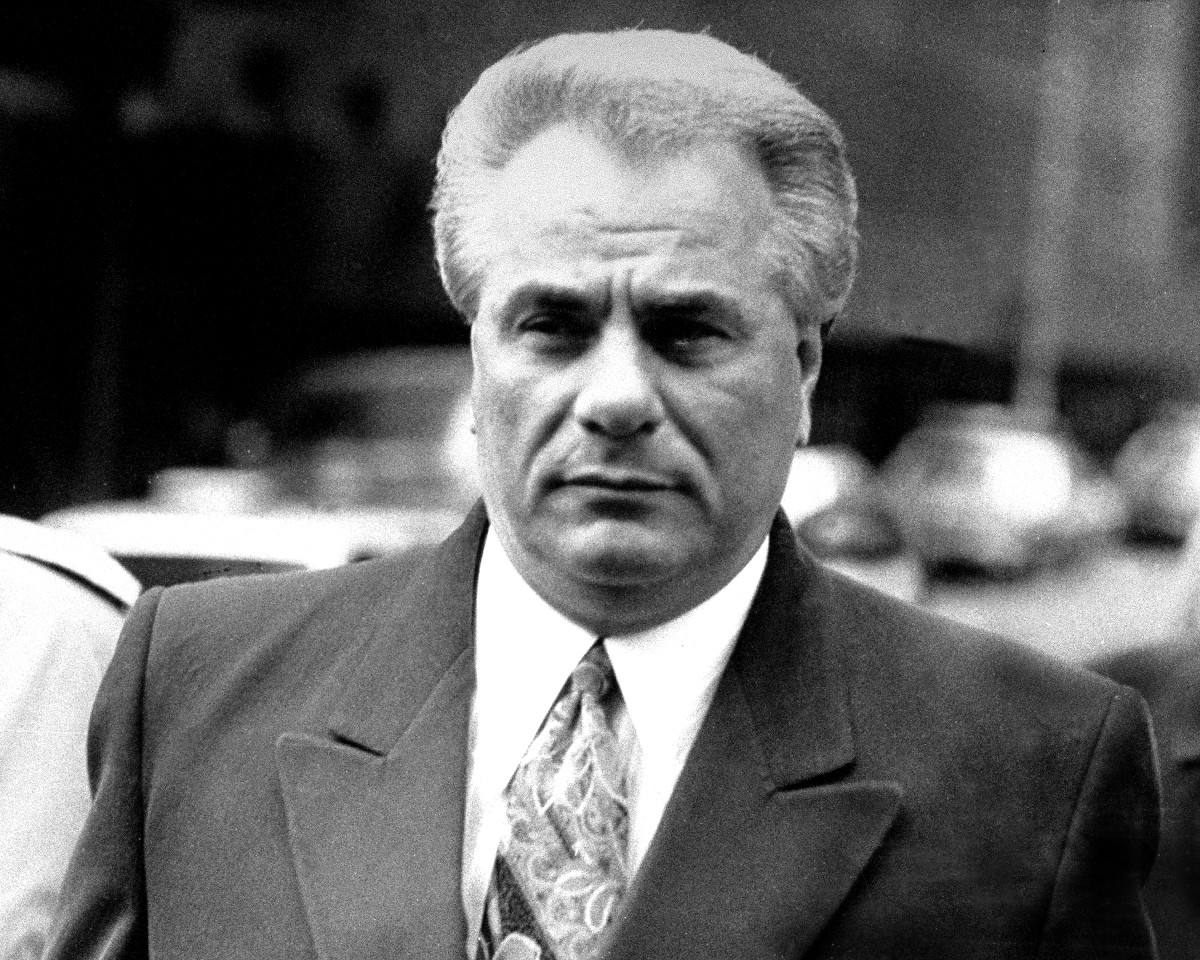
Paul Castellano – Eighth Grade Drop Out to Gambino Family Boss Part I

Constantino Paul “Big Paul” Castellano was born on June, 26 1915 in Brooklyn, New York. His mother’s name was Concetta and his father, a butcher and early member of the Mangano crime family, was named Giuseppe. Castellano had a sister, Kathryn who married Carlo Gambino, Castellano’s cousin and future boss of the Gambino crime family. Castellano had another relative named General Vito Castellano who was a commander in the New York National Guard and worked as the chief of staff for Gov. Mario Cuomo.

By the time Castellano was in the eighth grade he learned more helping his father run his gambling rackets than he did through school. Before the end of the year he dropped out and began working for us father full-time.

By the time he was in the 19 years old Castellano had gained a reputation of loyalty to mob associates. He had once been arrested for robbing another man and refused to identify his two accomplices to the police and served a three-month prison sentence.

By the early 1940s Castellano who had become a member of the Mangano crime family became a capo under new Mangano boss Albert Anastasia. As capo, Castellano ran his crew like a businessman making thousands of dollars each week, and pushing much of it up to Anastasia. Castellano continued growing his rackets throughout Brooklyn and New York into the 1950s.

Carlo Gambino

Carlo Gambino

On October 25, 1957 Albert Anastasia’s reign as boss came to an end when he was murdered. Due to Carlo Gambino’s loyalty to the commission, he was promoted to boss renaming the family the Gambino crime family. Gambino appointed Neil Dellacroce as his underboss. However, not long after Gambino appointed Paul Castellano as a second underboss to the Gambino crime family. Castellano would control many of the unions, and business aspect of the family while Dellacroce maintained traditional mom business i.e. loansharking, extortion, etc.

Although Castellano was more of a businessman than traditional mafioso, on occasion he would show his violence I. In 1975 he ordered the murder of his daughter’s boyfriend who had compared him to Frank Perdue, the owner and spokesman for Perdue Farms. Castellano considered this an insult and wasted little time in having the young man killed. In 2004 when Bonanno crime family boss Joseph Massino turned informant, he described having received the contract to kill the young man.

In late 1975 Castellano was awarded the position of acting boss of the Gambino crime family after Carlo Gambino became ill and announced Castellano as successor. The decision to appoint Castellano as boss was not a favorable one and widely considered one of Gambino’s worst decisions as head of the most powerful crime family the United States. Much of the family was behind his longtime underboss Neil Dellacroce having had the most contact with the caporegime’s and soldiers of the family.

As a powerful crime boss Castellano continued to run the family as more of a business than an organized crime unit. Castellano took control of several non-legitimate businesses and using his business contacts and power turn them into legitimate businesses earning he and his family millions.

One such business Castellano named Dial Poultry a distribution business supplying over 300 butcher’s in New York City. It wasn’t all legitimate though, Castellano had to cut corners to make his business profitable venues extortion to force his customers to buy his product.

Another legitimate business Castellano had control of was named Scare-Mix Concrete Corporation. This company, run by his son Philip controlled all the concrete construction business in Staten Island. Outside of Staten Island, Castellano sat in the driver seat for the underworld’s “Concrete Club”, where several of the New York mob families divided the revenue from all the New York developers. It’s been said that any development needing more than $2 million in concrete would need approval from the Concrete Club before moving forward.

As if controlling Staten Island’s concrete business and sitting at the table of the concrete club wasn’t enough, Castellano also controlled the local Teamsters union chapter 282, which provided the workers that poured the concrete to all the major building projects in New York.

On October 6, 1976 Carlo Gambino died at his home of a heart attack. Castellano was now completely in charge of the Gambino crime family. Dellacroce, true to his promise to Gambino announced to all of his supporters that Castellano was boss and that the family should stand behind him as one. Dellacroce remained the underboss of the family and retained the power of the capo’s and soldiers. Castellano would continue to run the white-collar businesses while Dellacroce continue to handle traditional Mafia activities.

In 1978 Gambino associate Nicholas Scibetta was murdered at the request of big Paul Castellano. Scibetta was a known drug user and alcohol abuser and according to Castellano was bringing too much heat on the family and had to go. Castellano gave the contract to Frank DeCicco, but first DeCicco was to notify Scibetta’s brother-in-law, Sammy Gravano. Sammy was not too pleased with Castellano’s hit and some say that his decision seven years later along with John Gotti to execute Castellano and take over the Gambino family, was an easy one. Some years later in an interview, Gavano had this to say about Scibetta’s death:

“I was hoping that it would be like he just disappeared. It would be better for his mother and father. They knew he was a crazy kid. Maybe he had met somebody, some group of people, and run off. The bottom line is that I let it happen. That makes me just as guilty. I didn’t know the body would be chopped up afterwards. That’s not me.” Sammy Gravano.

Over the next two years Castellano would order the murders of at least three more men. His favorite hit man of choice? Roy DeMeo, a fearless killer for the Gambino family notorious for cutting up the victims and dropping their body parts in several locations. Over the course of five years, body parts washed up on shore, found in dumpsters, and located under bridges in one of several mafia graveyards.

Carlo Gambino – The End

     On July 13, 1967 Gaetano “Tommy” Lucchese developed a fatal brain tumor and died at his home in Long Island. Over 1000 mourners attended his funeral including several levels of Mafia associates, politicians, and placement. Gambino organized the funeral and hand-picked Carmine “Gribbs” Tramunti as Lucchese’s successor.

     On June 28, 1971 Joe Colombo boss of the Colombo crime family was set to speak at the second annual Congress of Italo-America Organizations rally, a division of his Italian-American Civil Rights League when he was shot by an African-American man who was subsequently shot and killed by Colombo security guards. Although shot in the head, Colombo didn’t die of his wounds but stayed in a vegetative state until his death in 1977. Speculation around his assassination revolves around several factors, one being the American Mafia’s distaste for Colombo and the spotlight he brought upon organized crime. It’s been passed around that crazy Joe Gallo organized the hit using black gang relationships he developed while in prison. The increasing media attention by Colombo and his league was too much to bear and Gallo was looking for retribution from an earlier fight. The scenario could in fact be true as Joe Gallo was murdered not long after on April 7, 1972.

     Another scenario puts Carlo Gambino as the person who ordered the hit and Colombo for bringing too much attention to Cosa Nostra, but this theory has not been proven as Gambino had nothing to gain from Colombo’s death.

Charles "Lucky" Luciano

Charles “Lucky” Luciano

On January 26, 1962 Charles “Lucky” Luciano died of a heart attack while walking through Naples international airport on his way to Germany. Although he was kicked out of the United States for life, in death he was allowed to be buried at St. John’s Cemetery in 1972 more than 10 years after his death. Over 2000 mourners attended his funeral. Carlo Gambino, a friend and confidant of Luciano was the only boss of New York to attend his funeral.

     By 1972 Gambino was under watch by the FBI, had dealt with family members kidnappings and death, and was growing increasingly upset by the actions of his underboss Neil Dellacroce and his protégé John Gotti. Until this point Gambino had managed to rise to the top of the American Mafia by keeping a low profile and managing his businesses quietly. However, with many of the men he grew up with now dead, and as the most powerful boss in the United States he was facing increased pressure and began to reorganize the Gambino crime family.

     His first order of business was to restructure the hierarchy and put in place a second underboss below him. Neil Dellacroce, his longtime underboss and apparent air to the throne was already established having several men working under him. Gambino promoted his brother-in-law Paul Castellano as the second underboss, and where Dellacroce knew how to handle the up-and-coming mafioso and the dirty side of the business, Castellano was more of a businessman. Gambino put Castellano in charge of all the white-collar crimes through Brooklyn. He controlled the recycling, construction, unions, and wire fraud businesses that brought in millions each year to the Gambino crime family. The move to create a second underboss effectively split the family down the middle, one side being led by Dellacroce and the other by Castellano. It was effective and brilliant. It was also one of the last major decisions of the long time mafia boss.

New Gambino family boss, Paul Castellano    

On October 15, 1976 Gambino suffered a heart attack and died at his home. Before his death Gambino met with the hierarchy of his family and appointed his brother-in-law Paul Castellano as his successor, a blow to his longtime underboss Neil Delacroce and one that would spark one of the most public Mafia boss assassinations in history.

Carlo Gambino –One the Sidelines Part 3 of 4

     Early 1962 was the start of a Profaci family battle. Joe Gallo and his brothers battled with ailing Profaci crime boss Joseph Profaci over, among other things, the amount of money Profaci demanded from his family as tribute. In February 1962, the Gallo’s kidnapped Profaci underboss Joseph Magliocco and capo Joe Colombo in an attempt to force Profaci into revising how profits were divided between the family. After some time in captivity a meeting took place and both sides came to terms with a mutual agreement/ Profaci, however had no intentions of changing his policy. He was suffering from cancer and not ready to relinquish control of the family. After the kidnapped men were released he began to act his revenge against Gallo and his crew. He began with murdering Joseph “Joe Jelly” Gioelli, a Gallo crew member. Soon after, police interrupted an attempt on Larry Gallo’s life.

New Profaci crime family boss, Joseph Magliocco

New Profaci crime family boss, Joseph Magliocco

After the attacks the Gallo crew responded by attacking Profaci’s men wherever and whenever they saw them. Gambino and Lucchese sided with the Gallo crew and were applying pressure to the other members of the Commission to force Profaci to step down. On June 6, 1962 the war between the Gallo crew and Profaci faction ended when Joseph Profaci lost his battle with cancer. He was replaced by his longtime underboss Joseph Magliocco who had every intention of continuing the Profaci Gallo war. But it wasn’t too be; Joe Gallo was arrested, tried, and sent to prison while the rest of the Gallo crew dispersed. Magliocco was then free to focus on building up the Profaci family and increasing territory.

     Soon after the end of the war, another much more brazen attempt emerged from the Profaci family. Joe Bonanno who had aligned himself with Profaci and Magliocco during the Gallo war approached Magliocco with a plan to murder the heads of the other three families and take over the Commission. Magliocco looked to establish his own legacy and agreed to go along with the plan. They hired Profaci capo, Joseph Colombo to orchestrate the assassinations. However, Colombo was the wiser and realized the plan would not go very far and likely end in his death. Soon after his meeting with Bonanno and Magliocco, Colombo warned Gambino about the conspiracy to take over the commission. Choosing to watch from the sidelines through the Profaci Gallo War, Gambino’s life was threatened. He would need to act, but murder was not the answer.

     Instead, Bonanno and Magliocco were “sent for” by the commission to face judgment for their actions, but Bonanno fled leaving Magliocco to face the consequences alone. The commission believed Magliocco was following Bonanno’s lead, and although the penalty for such conspiracy is death, Magliocco was fined $50,000 and forced to retire. For his act of loyalty to the commission, Joseph Colombo was named as the new boss of the Profaci’s and renamed it the Colombo crime family. Colombo also gained a seat on the Commission. One month after losing control of the Profaci family Magliocco died.

     With Magliocco gone and Bonanno’s failure to stand up for his actions, the Commission felt he no longer deserved to be leader of the Bonanno crime family and removed him as boss. He was replaced by Gaspar DiGregorio a caporegime in the family.

     Bonanno felt he was disrespected by the Commission and by members of his own family, and set out to regain control by breaking the family into two groups, one led by DiGregorio, and the other by Bonanno and his son Salvatore. This was the start of the first Bonanno war dubbed in the newspapers “The Banana Split.”

Joe Bonanno

Joe Bonanno

With Bonanno fighting for leadership in the family, the commission felt it had to take drastic measures to end what could be the bloodiest war in Mafia history. At the time Gambino sat at the head of the commission and would need to be the person to issue the contract on Bonanno, however he decided to give Bonanno one last chance to retire. In October 1964 Bonanno was kidnapped by members of the Buffalo crime family who said they were acting on orders from the commission. After some time Bonanno was released and the Commission expected he would retire, leaving the family in one piece under DiGregorio.

     With Bonanno Senior seemingly out of the picture, DiGregorio agreed to a peace meeting with Bonanno’s son Salvatore. When Salvatore and his men arrived at a house where the meeting was to take place they were welcomed with rifle and automatic weapons fire from DeGregorio’s men. Salvatore and his men returned fire and over 500 shots were fired but no one was hit.

     For the next two years Bonanno’s son and his loyalists fought against DiGregorio and his men for control over the Bonanno family. The Commission thought DiGregorio would eventually win the war, however when Bonanno Sr. returned and issued a decree stating for every Bonanno loyalist killed, he would retaliate by hitting a caporegime from the other side. With momentum on the side of the Bonanno’s, and victory within reach, DiGregorio and the Commission considered letting Bonanno regain control of the family, but when Bonanno suffered a heart attack, he recused himself from the war and retired to Arizona with his son. Before he left he named Bonanno capo, Paul Sciacca as his successor. The commission agreed and DiGregorio stepped aside. By this time, Gambino and his reputation of “mercy” towards Bonanno made him even more of a respected mafioso in the eyes of the Commission.

     In the early 1970s Gambino was still on top as the most powerful mafioso in the United States, however there were some out there who had the guts to disrespect him. In one such situation in October 1974, a feared Colombo soldier named Carmine “Mimi” Scialo, who controlled much of Coney Island, was drunk at a popular Italian restaurant when he spotted Carlo Gambino. Scialo, began insulting Gambino in front of others at their table and according to witnesses, Scialo stopped short of threatening Gambino’s life. During the assault Gambino stayed calm as he always did and waited for Scialo to lose steam and leave. Gambino never spoke of the insults and continued with dinner. Scialo’s body was found encased in the cement floor at Otto’s Social Club in South Brooklyn a short time later.

Carlo Gambino – A Low Profile Rise to Power Part 2 of 4

Luciano crime family boss Charles "Lucky" Luciano

Luciano crime family boss Charles “Lucky” Luciano

Vincent Mangano had a 20 year reign as the Mangano crime family boss. Until that point in history no other crime boss controlled a family for as long as he did. He was successful, feared, and envied by gangsters all across the country.

If Mangano was the brains of the family, his underboss, Albert Anastasia was the muscle. Though the two rarely agreed on the direction of the family, but Mangano allowed Anastasia to run wild as the “Lord High Executioner” of the syndicate’s most notorious death squad, Murder, Inc. Anastasia and his murderous crew were used as commission henchmen when a member of the families got out of line. They killed hundreds of men.

Since childhood Anastasia held a tight friendship with Charles “Lucky” Luciano and Frank Costello. Luciano is responsible for creating the commission and was the most powerful mafioso in the country. Costello had a significant amount of power as well working in the Luciano crime family. Together the men used Anastasia and Murder, Inc. without the permission of Mangano to settle disputes and increase their territory. Mangano and his brother, Phil, confronted Anastasia several times about his relationship with the Luciano family. They attempted to discourage Anastasia from working with the competition, however Anastasia disagreed. As tension increased Anastasia stopped asking permission for “every little thing,” further angering the Mangano’s.

The disagreement came to an end on April 19, 1951 when Philip Mangano was found murdered and Vincent Mangano disappeared and was never found. Anastasia lobbied the heads of the other crime families claiming Mangano and his brother were plotting to have him killed. Frank Costello, the acting boss of the Luciano crime family after Lucky’s incarceration, backed up Anastasia story. The commission agreed, and Anastasia became the new boss of the family, with Carlo Gambino as his underboss. Gambino who remained neutral throughout the disagreement was now just one notch away from being the most powerful mobster in the country, with a crew making profit of extortion, illegal gambling, hijacking, bootlegging and murder. He controlled more businesses and territory than several families combined.

With Anastasia at the helm, the renamed Anastasia family was profitable and dangerous. It wasn’t long before several up-and-coming mobsters began to question Anastasia’s policies. Vito Genovese brought his concerns to the incarcerated Luciano and Luciano family acting boss Frank Costello who assured him Anastasia could be trusted. Genovese didn’t think so and in 1952 his doubts were magnified when Anastasia ordered the murder of a Brooklyn tailor’s assistant named Arnold Schuster who had witnessed a bank robbery at the hands of Willie Sutton.

Anastasia’s brazen murder violated a cardinal Mafia rule against killing outsiders and brought unnecessary public scrutiny on Mafia business. Luciano and Costello were dumbfounded at Anastasia’s decision to have the man killed, but couldn’t risk losing Anastasia’s allegiance to the Luciano crime family. Not only was Genovese maneuvering to take over the Anastasia family, but was also positioning himself to take over several profitable Luciano rackets. They needed Anastasia to keep control of the commission and out of Genovese’s hands.

In 1957 Vito Genovese convinced Carlo Gambino to side with him against Anastasia, Costello, and Luciano. Genovese devised a plan to convince Anastasia that they were not making enough money from the casinos in Cuba. He used Gambino to deliver the message to Anastasia that Meyer Lansky, the man in control of the casinos in Cuba, was holding out on them. When Anastasia confronted Lansky about the missing money, Lansky threw his support to Genovese and Gambino.

A short time later, Genovese hired Vincent Gigante to assassinate Frank Costello. Though Gigante’s attempt failed, Costello, who wasLuciano family acting boss, Frank Costello no longer a young man, asked the commission for permission to retire. His request was granted and Genovese took over the Luciano family and renamed it the Genovese crime family. As this happened, Lucky Luciano had been deported from the United States and lost nearly all power. He was in no position to fight back against the more powerful Genovese.

With his power growing Genovese moved against Anastasia. On October 25, 1957 in a small barbershop on the first floor of the Park Sheraton hotel in New York City, Genovese gunmen assassinated Albert Anastasia. With his death Gambino became the boss of the Anastasia crime family which was renamed the Gambino crime family.

Genovese was now the most powerful mobster in the country and had positioned himself to control the mafia commission. He put in motion a meeting in Apalachin, New York where the heads of all the families would meet to formally crown him the “boss of bosses.”
When most of the men were in attendance and before the meeting began, the police raided the conference and destroyed Genovese’s rise to power. The blame for the disaster was put on Genovese’s shoulders and with that momentum Gambino met with Costello, Luciano, and Lansky in Cuba to come up with a plan to get rid of Genovese.

In 1959 Genovese was arrested in Atlanta when he arrived to pick up a large shipment of heroin. He was convicted for distribution of a controlled substance and sentenced to 15 years in the Atlanta Federal Penitentiary. With the support of Costello and Luciano, Gambino was named head of the commission in 1962. In prison Genovese heard of Gambino becoming the new “boss of bosses” and couldn’t understand how a man who had kept a low profile still became the most powerful boss in the country.

Gambino wasted little time and quickly expanded his rackets all over the United States. No part of the country was out of his reach including Los Angeles, Las Vegas, Chicago, Miami, and Boston. With the help of his caporegimes, Aniello Dellacroce, and brother-in-law Paul Castellano, Gambino took back control of Manhattan from the remaining Anastasia loyalists and Genovese crews.
In the 1960’s at the height of his control Gambino controlled more than 90% of all New York City’s ports including the New York Longshoreman Union. The Gambino family had as many as 800 soldiers spread out in 30 crews across the country. All combined the family made more than $500 million a year.

Carlo Gambino – American Mafia Made Man at 19 Part 1 of 4

     “Don” Carlo Gambino was born on August 24, 1902 in Caccamo, a province of Palermo Sicily. He had two brothers, Gaspare who was never involved in the Mafia, and Paolo who would eventually work alongside his brother in the American Mafia.

     In Italy, Gambino’s family belonged to the Honored Society, an Italian version of the Black Hand in the United States. The Black Hand was a less organized version of Italian gangsters, most of which immigrated to the United States.

     In 1921 Gambino illegally boarded a ship headed for the United States. It’s been said he ate nothing but anchovies and wine during the month-long trip. Once in the United States he joined his cousins, the Castellano’s in New York City. The Castellano’s were already affiliated with the D’Aquila gang, and quickly introduced Gambino as a new member. By the end of 1921 at the age of 19, Carlo Gambino became and “made man” of the American Mafia.

Jewish Gangster Meyer Lansky

Around the same time Gambino also became close with an Italian and Jewish gang called the “Young Turks” in New York. The gang included notables such as, Frank Costello, Albert Anastasia, Frank Scalise, Settimo Accardi, Tommy Lucchese, Joe Adonis, Vito Genovese, Meyer Lansky, Bugsy Siegel, and Mickey Cohen. The Turks were led by Charles “Lucky” Luciano, the future creator of the mafia Commission.

     After several years of fighting for territory among the different gangs in and around New York, two men emerged holding the most power. Giuseppe “Joe the Boss” Masseria and Salvatore Maranzano a Palermo bore mafioso who recently arrived in the United States. Maranzano quickly inserted himself in extortion and gambling operations that directly competed with Masseria. On October 10, 1928 Masseria had rival Toto D’Aquila, once the most powerful mobster in New York, murdered clearing the way for him to become the “Boss of Bosses”. However, Maranzano and the Castellammarese Clan he brought with him from Palermo, stood in his way.

     In 1930, Masseria flexed his muscle and went after Marranzano’s then boss, Nicola “Cola” Schiro demanding a $10,000 tribute. Schiro, fearing for his life against the more powerful Masseria paid the tribute, and fled New York leaving Maranzano as the gang’s new leader. It was this move that set the wheels in motion for the start of one of the largest gangland wars in history; the Castellammarese War.

     By 1931, Masseria had begun to eliminate Maranzano’s Castellammarese Clan. His goal was to weaken Maranzano and take over New York. However, Maranzano would not go down without a fight and declared war on Masseria and anyone else who aligned themselves with him.

     Gambino and Alfred Mineo the new leader of the D’Aquila gang aligned with Masseria. Half of the Young Turks joined as well, with the others aligning with Maranzano.  The Castellammarese Clan included Joe Bonanno, Stefano Magaddino, and the Profaci crime family, which included Joseph Profaci and Joseph Magliocco. Former Masseria allies Gaetano Reina, boss of the Reina family and Tommy Lucchese also joined the Castellammarese and Maranzano.

     The war went on between these two factions for nearly 4 years. It was the height of prohibition where profits were large; however the war almost completely destroyed many of the New York family rackets. Luciano and members of the Young Turks from both sides began to realize the war needed to stop and stop soon or much of what they took so long to build in New York City would be lost. During the war many of the Jewish and Irish crime families became the dominant families in New York. Meyer Lansky, a Jewish mobster and close confidant of Luciano felt that Masseria and Maranzano were old-school mafioso who were too greedy to see the riches that could be had by working with non-Italians. Gambino and the Young Turks agreed and decided to end the war and form a national syndicate led by Charles Luciano.

     On April 15, 1931 Masseria was murdered by Luciano associates Albert Anastasia,

Joe “the Boss” Masseria dead with an Ace of Spades in his hand. This card was likely planted.

Joe Adonis, Vito Genovese, and Bugsy Siegel while dining at Nuova Villa Tammaro restaurant in Coney Island. With Masseria out of the way, Marranzano declared himself the Boss of Bosses and with the help of Luciano’s vision, re-organized the New York gangs into five Mafia families. Vincent Mangano was promoted and took over Masseria’s Mineo family. Young Turk, Albert Anastasia became his underboss and Gambino was promoted to Capo.

     On September 10, 1931 Maranzano was murdered by Luciano gunmen ending his reign as Boss of Bosses. With Maranzano gone Luciano called a meeting of all the bosses in New York and the United States. During this meeting many of the bosses including Al Capone of the Chicago Outfit expected Luciano to declare himself Boss of Bosses. However, Luciano had another idea and during the meeting laid out his plan to create The Commission, a ruling panel of crime family leaders which would mediate conflicts between the families. The leaders nominated Luciano, Joe Bonanno, Joe Profaci, Tommy Gagliano, and Vincent Mangano as its inaugural members.

     With a seat on the Commission, the Mangano family set out to become one of the most powerful mafia families in the country. Gambino quickly became one of the family’s top earners and controlled several illegal rackets including loansharking, illegal gambling, and protection.


Hit Counter provided by Skylight