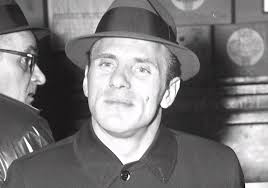
Greg Scarpa, Sr. – “the Grim Reaper” and 30 Year FBI Informant

Greg Scarpa, Sr., was born on May 8, 1928 near Venice, Italy and immigrated to the United States with his parents and brother Salvatore at a young age.

The 1950’s were a busy time for Scarpa. He married Connie Forrest and had four children, maintained a relationship with girlfriend Linda Schiro having two more children, and was introduced to the Colombo crime family by his brother Salvatore.

Scarpa was a successful gangster from the very beginning and it wasn’t long before he became heavily involved in illegal gambling, loansharking, extortion, hijacking, murder, assault, theft, and narcotics trafficking. As a gangster he wore stylish clothes and carried large amounts of cash in his pocket for purchases and bribery. He owned apartments and homes in Manhattan, Florida, Brooklyn, and Las Vegas. As his power grew his reputation for violence and murder grew as well eventually earning him the nickname “the Grim Reaper”. Shiro later said that Scarpa would sometimes leave the numbers “666” on his victim’s pagers.

In March 1962 law enforcement arrested Scarpa for armed robbery. If convicted he would serve a lengthy prison sentence which would certainly cripple his growing empire. As a high ranking member in the Colombo crime family the FBI provided Scarpa with a chance of freedom provided he was willing to give information to them from time to time regarding organized crime. He accepted and became an informant for the Federal Bureau of Investigation, a relationship that would last 30 years.


** EDS NOTE GRAPHIC CONTENT ** FILE ** In this 1964 file photo released by the FBI, the bodies of three civil rights workers are uncovered from an earthen dam southwest of Philadelphia, Miss. The photograph was entered as evidence by the prosecution in the trial of Edgar Ray Killen, who was convicted in 2005 for three counts of manslaughter in the deaths of James Chaney, Andrew Goodman and Michael Schwerner. (AP Photo/FBI, File)

** EDS NOTE GRAPHIC CONTENT ** FILE ** In this 1964 file photo released by the FBI, the bodies of three civil rights workers are uncovered from an earthen dam southwest of Philadelphia, Miss. The photograph was entered as evidence by the prosecution in the trial of Edgar Ray Killen, who was convicted in 2005 for three counts of manslaughter in the deaths of James Chaney, Andrew Goodman and Michael Schwerner. (AP Photo/FBI, File)

In the summer of 1964 three Mississippi Civil Rights workers were reported missing and suspected of being murdered by the Ku Klux Klan. According to Schiro and other sources, the FBI was having trouble finding their graves and recruited Scarpa to help locate them. At the time Scarpa was widely known as an aggressive mafioso and a formidable interrogator. The FBI used Scarpa and his skills to kidnap a TV salesman and known Klansman named Lawrence Byrd who is suspected of having information on the three workers. Scarpa and FBI agents took Byrd to Camp Shelby a local Army base where they severely beat him until he revealed the location of the civil rights workers graves.The FBI never officially confirmed Schiro’s account of the story. Instead investigative journalist Jerry Mitchell and another man claimed a Mississippi highway patrolman named Maynard King provided the grave locations after receiving a tip from an anonymous third party.

 Scarpa was eventually dropped as a confidential informant by the FBI in January1966, but their relationship was renewed in 1980 when FBI agent Lindley DeVecchio approached Scarpa and convinced him to cooperate again.

DeVecchio and Scarpa had a tight relationship that some say involved numerous illegal dealings of cash, jewelry, and gifts. In return DeVecchio provided Scarpa with information about his enemies during the third Colombo war and likely saved his life in the process. The two worked together for over 10 years often meeting alone in apartments or hotels provided by the FBI where they would exchange information. In one such meeting Scarpa gave DeVecchio a hard-to-find Cabbage Patch doll for his daughter just in time for Christmas.

Scarpa was arrested in 1985 and charged with running a major credit card scam. He pled guilty and was awaiting sentence when DeVecchio submitted a memo to the judge that listed all of Scarpa’s contributions to the FBI. Scarpa was eventually sentenced to five years probation with no prison time and a $10,000 fine. He may have gotten off lightly, however some of the Colombo soldiers were surprised at the leniency of the court and suspected Scarpa might have a relationship with the government.

In 1991 the Colombo family was involved in a power struggle. On one was side Colombo boss Carmine Persico and the other, acting boss Victor Orena. During the war Persico loyalist unsuccessfully attempted to murder Orena. Instead of retaliating against the highly protected Persico, Orena sent his men to murder Scarpa who a staunch Persico allie.

November 18, 1991 hitmen converged on Scarpa’s vehicle with guns drawn, but Scarpa managed to drive away before any shots were fired. Scarpa was infuriated at the attempt on his life and over the next several months traveled through Brooklyn looking for Orena loyalists in social clubs and bars. At the end of the war Orena supporters Rosario Nastasa, Vincent Fusaro and James Malpiso were dead. Malpiso was gunned down while hanging Christmas lights on his home.

In 1992 Scarpa, who is in poor health after contracting the AIDS virus from tainted blood, was arrested for violating state firearms laws and indicted on federal racketeering charges involving three murders. He was placed under house arrest awaiting trial.

1990's Greg Scarpa Sr.

1990′s Greg Scarpa Sr.

On December 29, 1992 Lucchese crime family gangsters Michael DeRosa and Ronald Moran threatened Scarpa’s stepson Joey over a drug deal. Although he was in poor health Scarpa climbed out of bed and drove with Joey to DeRosa’s house to confront the two men. Fearing for their lives a gunfight erupted and DeRosa was shot twice in the chest and Scarpa was shot once in the eye. After arriving at the hospital prosecutors revoked Scarpa’s house arrest and send him to jail.

On May 6, 1993 Scarpa pled guilty to three murders and conspiracy to commit murder. In frail health and blind in one eye he was sentenced to life in prison on December 15, 1993, but the sentence was reduced to 10 years due to his poor health. He died on June 4, 1994 in the Federal Medical Center for prisoners in Rochester Minnesota.


Joseph “Crazy Joe” Gallo – Profaci Crime Family Enforcer and Hitman

Joseph “Crazy Joe” Gallo was born in the Red Hook section of Brooklyn, New York on April 7, 1929 and is one of three sons to Prohibition bootlegger Umberto Gallo. His brother’s Larry and Albert “Kid Blast” Gallo were never deterred from entering a life of crime from their parents. Subsequently each of the brother’s became involved in organized crime.

By 1949 Gallo had earned the nickname Joe the Blond for having a chest full of blond hair that he promoted by wearing unbuttoned shirts. In 1950 Gallo was arrested and sent to Kings County Hospital Center where he was diagnosed with schizophrenia. By that time, Gallo was already working with Joe Profaci, boss of the Profaci crime family and future Colombo crime family as an enforcer and hitman.

As an associate of the Profaci family, Gallo was also put in charge of several high stake card games, extorsion rackets, and numbers games. Having a feared enforcer controlling the rackets lessened the odds someone would attempt a takeover or robbery. During this time, the rackets flourished and Gallo , a smart businessman compared to others, put himself in position to own several Manhattan nightclubs and sweat shops and increase his wealth.

In 1957 its alleged Joe Profaci asked Gallo and his crew to murder the boss of the modern day Gambino crime family Albert Anastasia. Carlo Gambino, Anastasia’s underboss wanted to take over as boss of the family after Anastasia’s murderous group became a liability for the family. However, as the leader of Murder Inc., a mafia hit crew attributed to over 200 murders; Anastasia would not be easy to kill.

On October 25, 1957, Anastasia entered the Park Sheraton Hotel barber shop. While he was seated awaiting a shave, two gunmen entered the shop and began firing at Anastasia. Reports say Anastasia lunged at the hitmen’s

Albert Anastasia, founder of Murder Inc.

shadows before falling to the floor dead. Zthe gunmen left the building and were never caught. To this day, there are reports the gunmen were from several other families, but no conclusive evidence has ever surfaced.

              In the early 1960’s Gallo was making a run against his old mentor Joe Profaci. Profaci was increasing tributes from the family and Gallo disagreed so he devised a plan to kidnap the entire leadership and use their lives to barter against the increase with the commission. During the kidnap attempt, Profaci escaped, but four of his capo’s and his brother-in-law and underboss Joe Magliocco were captured. According to records, Gallo wanted to kill one of the hostages and demand money before the negotiations began but his brother Larry convinced him otherwise. Within weeks, a deal was met and Profaci reduced the amount of tribute money for the Gallo crew and all the men were released unharmed.

            Although peace was negotiated, Profaci wasn’t happy with Gallo forcing his hand and began planning his revenge. In May 1961 Profaci teamed up with Carmine Persico to eradicate the entire Gallo crew. Within days gunmen had murdered Gallo’s top enforcer Joseph “Joe Kelly” Gioelli. His clothes were left at the front door of a restaurant frequented by Gallo and the rest of his crew; a clear message they had a fight on their hands.

            In August of the same year, Larry Gallo was next on the list to be killed. He was lured to a Brooklyn supper club where Profaci hitmen including Persico lay in wait. Once he entered the building he was attacked and nearly strangled to death. If it wasn’t for a passing police officer who stopped the attack, Larry would have been killed. This attack officially started a war between followers of the Profaci/Persico team and the Gallo crew who retreated to a safe house on President’s Street.

            The remainder of the year was tough on the Gallo crew. They were hold up in their apartment and rarely left without heavy guard. As the year continued, money became a focus for the men as they were not able to collect from their usual rackets. Gallo resorted to extorting money from nearby establishments. Gallo was arrested after trying to extort a local cafe owner. He was subsequently tried and convicted of extortion, and on December 21, 1961 he was sentenced to 7 – 14 years in prison for the crime.

            Gallo was released from prison in 1971 after serving 10 years. At his parole hearing an officer at the prison testified for Gallo and described a scene to the court. During a riot the guard was attacked by several inmates. He was certain they would kill him, but before they could, Gallo fought off the attackers and saved the officer’s life. His clean history while serving time and the guard’s story aided in his release.

            Upon leaving the prison his then wife remarked how he had become frail and pale while in prison, but not discouraged. He was determined as ever to gain the top spot on the Profaci family now called the Colombo family after the death of Joe Profaci in 1962, and the commission’s appointment of Joseph Colombo Sr. as the new boss.

            After Gallo’s release from prison Colombo and Joseph Yacovelli met with him and delivered a gift of $1000. Gallo responded to Colombo that he was no part of the peace treaty the commission had established while he was in prison. He asked for $100,000 to keep the peace. When the commission heard of Gallo’s answer, they immediately issued an order to kill him.

            On June 28, 1971 at the second meeting of the Italian-American Civil Rights League, a foundation created by Joe Colombo, a gunman emerged from the crowd and shot Colombo in the head. Colombo bodyguards returned fire killing the assassin later identified as Jerome Johnson an African American. Colombo survived the shooting but maintained a vegetative state until his death years later.

            The official police investigation concluded Johnson acted alone and had no ties to organized crime. Despite the police investigation, the mafia commission received word that while in prison Gallo had recruited several African American men to his crew. Johnson was thought to be part one of them. After discussions, the mafia commission increased their intensity to have Gallo killed.

            On April 7, 1972 Joe Gallo celebrated his 43rd birthday with his family. The night began at Manhattan restaurant until the early hours of the morning and moved to Umberto’s Clam House in Little Italy. In attendance were Gallo’s sister, wife, daughter, bodyguard, and the bodyguard’s female companion. He was spotted by Colombo associate Joseph Luparelli who promptly left the restaurant for a Colombo hangout a few blocks away where he recruited Colombo associates Philip Gambino, Carmine DiBiase, and two other men to kill Gallo.

Umberto’s Clam House the morning of the shooting.

At 4:30 a.m. four gunmen entered Umberto’s Clam House and open fired at Gallo. According to witnesses Gallo pulled a revolver of his own, flipped over a table and returned fire. Over 20 rounds were fired at Gallo. He was hit in the buttocks, elbow, and back. After the gunmen fled Gallo staggered to the through the front door and collapsed on the street. Some say he was trying to divert the gunmen from his family and friends. Others say he was trying to flee. When police arrived, the badly wounded Gallo was placed in a squad car and rushed to the nearest hospital were he died.

Benedetto “Benny” Aloi – High Profile Defendant in the Infamous 1990′s “Windows Case”

Benedetto “Benny” Aloi was born on October 6, 1935 and had one sibling, a brother named Vincenzo “Vinnie” Aloi.  His father, Sebastian “Buster” Aloi was a soldier in the Profaci crime family and is responsible for bringing his sons into the La Cosa Nostra.

Aloi spent much of his childhood like any other child hanging around his brother and friends and working his way through school. On occasion Aloi would visit his father at the local Profaci hangout where he would run errands and learn about the life of a goodfella.

By his twenties, Aloi was fully integrated in the Colombo crime family formally the Profaci family. By that time his father was a caporegime and handed Aloi and his brother several enterprises to control. One of the most profitable was a garment trucking business that provided substantial income to the Colombo family.

By his thirties, Aloi was one of several hundred mafioso in the sights of the FBI. On November 19, 1974 Aloi and over 150 other members of La Cosa Nostra were indicted on perjury charges.  Aloi was one of a few that were never tried.

By the 1980’s Aloi who had risen to capo was being tracked again by the FBI when it was alleged that he was a involved with a capital finance group that would lend money at extremely high interest rates. The case never made it to court.

Aloi biggest threat came in the infamous “Windows Case” in the early 1990’s. The windows case involved four of the five New York crime families that used their control over the construction unions and local contractors to fix the price of their bids to the New York Housing Authority. During that time the authority was entrenched in a thermal window pane project that would provide new windows to thousands of homes in the projects of New York.

In May 1991, Aloi, now consigliere of the Colombo family was convicted on one count of extortion and one count of conspiracy. As a high profile defendant and convicted criminal, Aloi received five times the amount of time expected and was sentenced to 16 years and eight months in prison. He was released after serving his sixteen year sentenced and subsequent half way house time on May 18, 1991. It had been 18 long years since he had been free and the time behind bars had taken its toll. Aloi was 74 years old when he was released; far too old to get back in the family and learn the ways of the twenty-first century mafia. He officially retired as caporegime and lived out his days in seclusion. He died on April 7, 2011.

Joseph Anthony “Joe” Colombo Sr., Founder of “The Italian-American Civil Rights League”

      Joe Colombo was born in Brooklyn on June 16, 1923. Much of his early life is unknown; he lived with his parents, and had no other siblings. His father was a member of the American mafia until his murder in 1938. In his younger years Colombo held several legitimate jobs. He spent time in the U.S. Coast Guard, had jobs as a longshoreman, and in worked in a meat packing company. His last legitimate job was selling real estate.

      By the late 1950’s Colombo was fully involved as an enforcer for the Profaci crime family in New York. The Profaci’s were a tough family known as one of the “five families” of New York, and also held a seat on the mafia’s national commission.  As an enforcer Colombo‘s job was to collect money owed to the family and to take part in physical work ordered by his capo or higher ups. Colombo proved early on to be efficient in collecting money and extorting for the family and was quickly “straightened out” or officially inducted in the Cosa Nostra.

     During his career in the mafia, Colombo had several ‘scares’ or close calls. In one situation Colombo and other members of the Profaci leadership were kidnapped by a feared and disgruntled capo in the Profaci family, Joe Gallo. At the time, Joe Profaci, the boss of the family had been requesting larger tributes from Gallo, and the feud grew. Gallo wasn’t the only capo to have increased ‘taxes’ by the boss, but he made the biggest beef because of it. After holding the men for several weeks, an agreement was finally made where Profaci would lessen the tributes owed by Gallo, and Colombo and the other hostages were released. By the end of the year however, Profaci would renege on their deal and the first Colombo war started.

     On June 6, 1962 Joe Profaci died of liver cancer, and long time consigliere Joseph Magliocco took over as boss of the Profaci family. As boss, Magliocco pursued Gallo and his allies attempting several hits but none were successful. One such plot by Magliocco involved murdering the entire commission including Bonnano crime family boss, Joe Bonanno, Lucchese crime family boss, Tommy Lucchese, and Gambino crime family boss, Carlo Gambino. Magliocco handed the contract to Joe Colombo, who promptly revealed the plot to Lucchese and Gambino. With the admission, Magliocco was forced to retire, and Colombo was rewarded for his loyalty to Cosa Nostra and handed the Profaci family renaming it the Colombo crime family.

      At 41 years old, Colombo was the youngest crime family boss in the nation. He was also an avid supporter of Italian-American rights spending countless hours lobbying for equality. In early 1970 Colombo created the Italian-American Civil Rights League. He immediately went after the federal government citing several instances where they purposely prevented Italian-Americans from equal liberties in the work force. His work generated a massive response from the Italian-American community and with their support; Colombo’s league became the rally cry for action. On June 29, 1970 50,000 people showed up in Columbus Circle in New York City for an “Italian-American Unity Day” rally. Several U.S. Congressmen attended the event. Soon after, the League grew national attention, which was good for Italian-American’s but bad for the American mafia and the commission noticed. In November 1971 the League drew further publicity when Frank Sinatra headlined at a sold out show in Madison Square Garden. Later that year and into 1971 Colombo himself appeared in television interviews and speaking appearances for the League. In spring 1971 Paramount Pictures was forced to halt filming of “The Godfather” due to overwhelming sediment from the Italian-American community. Movie producer Albert Ruddy met with Colombo and agreed to excise the terms “Mafia” and “Cosa Nostra” from the film in exchange for the League’s backing. Colombo agreed and filming resumed.

     Colombo planned on building on his success with the League from the first Columbus Day rally and announced a second annual rally to be held on June 28, 1971 much to the displeasure from the commission. Prior to the rally the Colombo family nemesis, Joe Gallo was released from prison. During his time in prison, Gallo had spent his time building relationships with the other families and Harlem and Bedfod-Stuyvesant gangs of African-American descent. Upon his release, Colombo set up a meeting with Gallo to bury the hatchet so-to-speak, but Gallo refused. It’s said Colombo was going to offer Gallo $1000 to keep the calm. Gallo responded with $100,000 and the meeting never happened. A murder contract was immediately issued on Joe Gallo.

     On March 11, 1971 Colombo was convicted and sentenced to two and half years for perjury after lying on a real estate application many years before. His sentenced was delayed pending appeal.

     On June 8, 1971 Colombo arrived at his second annual “Italian-American Unity Day” rally. Thousands were in attendance along with Congressmen and entertainers. As Colombo was introduced and made his way to the stage, he was shot several times by an African-American man named Jerome Johnson who was wearing journalist credentials. He held a camera in one hand, and a pistol in the other. Several men including Colombo’s son jumped on Johnson however before they could wrestle him to the ground Johnson was shot three times in the back by an unknown African-American assailant who then fled on foot along with a women who initially arrived with Johnson. Neither was found.


Colombo being loaded into an ambulance after being shot.

Although he was shot several times at point blank range, Colombo survived the assassination attempt but never regained consciousness. He remained in a vegetative state until his death nearly seven years later when he died at his estate on May 22, 1978.

     Colombo’s murder was never solved, however because it was an African-American who committed the crime, and another who killed the gunmen, it’s believed Joe Gallo was to blame. Year’s later news emerged that Carlo Gambino was angered at Colombo’s actions and orchestrated the plot to kill Colombo. The NYPD largely influenced by the powerful Carlo Gambino eventually concluded that Jerome Johnson acted alone.

Joe Magliocco – 31 year Colombo Crime Family Consigliere

 Giuseppe “Joe” Magliocco was born in Castellammare del Golfo in Sicily in 1898. Magliocco was related by marriage to consigliere and underboss Salvatore Mussachio, Buffalo crime family boss Stefano Magaddino, Bonanno crime family founder Joseph Bonanno, and his closest confidant, Profaci family founder, Joseph Profaci. When he arrived in the United States he quickly took advantage of his relationships and was soon deep into illegal gambling and union racketeering.

On December 5th, 1928 Magliocco and Profaci attended the meeting of New York mobsters at the Statler Hotel, in Cleveland Ohio. The meeting was called to establish new territories for several New York mobsters after Salvatore D’Aquila boss of a powerful Brooklyn gang was murdered. Profaci was one of several bosses to receive territory. However, before the meeting was over, the Cleveland Police raided the meeting detaining several Mafioso including Magliocco who was the only person charged on an unrelated weapons violation.

In 1931, the Castellammarese War began in New York between the two most powerful Italian-American

Magliocco and Profaci

gangs. By the end of 1931, the war was over with both bosses dead, and the New York gangs divided into five crime families supervised by a Mafia Commission; established by Lucky Luciano. As a boss in New York, Profaci was invited to sit on the ruling panel and became one of the five original five family bosses. His first order of business was to name Magliocco as his underboss or second in command. He would be underboss of the Profaci crime family for the next 31 years.

 As Underboss of the Profaci family, Magliocco was invited to the 1957 Apalachin Conference with Joe Profaci. The meeting was a national meeting with an estimated 100 mobsters in attendance. The city of Apalachin wasn’t used to the traffic so when several dozen vehicles passed through town on their way to Joseph “Joe the Barber” Barbara’s house outside of town, the authorities noticed. Law enforcement assembled a team and raided the meeting. Magliocco and 60 other mobsters were arrested. On January 13, 1960, Magliocco and 21 others were convicted of conspiracy and sentenced to five years in prison. However, an appeals court eventually overturned the convictions. Many say the court and attorneys were bribed, but no one was ever charged.

As the 1950’s came to a close, strife within the Profaci family came to the forefront. Profaci required larger than normal tribute payments to be sent up each week and this upset several high ranking capo’s in the family including the Gallo brothers Joe, Larry, and Albert. The final straw came when Profaci ordered the killing of a Gallo associate Frank Abbatemarco. Business is business, and it’s thought the Gallo’s would have accepted the killing had they received Abbatemarco’s rackets after his death. However, when Profaci didn’t see it that way and distributed Abbatemarco’s rackets elsewhere, the Gallo’s were ready for war.

In February 1961, the Gallos kidnapped Maggliocco, Frank Persico, and then-capo Joseph Colombo. They held the men for several weeks until Profaci agreed to lighten up on the weekly tributes. The Gallo’s then released the three men. Within three months, Profaci reneged on their deal igniting on all out war between Profaci and his followers, and the Gallo’s and their followers.

On June 6, 1962, Profaci died of liver cancer. Magliocco stepped up and became the new acting boss of the Profaci family. However, the Mafia Commission did not endorse him as the new family leader. When Magliocco took over, the Gallo Profaci war was in high gear. There were shootings, bombings, and murder attempts conducted by both sides. Magliocco was no slouch and continued to fight for Profaci after his death. He also wanted to send a message to the other New York families that he was not weak. However, in 1963 with the jailing of Gallo and several associates, the hostilities ended. Magliocco knew it would be difficult for the commission to officially vote him in as the official boss of the Profaci family so when the vote was conducted and Joseph “Joe Bananas” Bonanno, a Profaci capo was awarded the family, Magliocco stepped back into his position as consigliere.

In 1963, Bonanno boss Joe Bananas began plotting to take out the leading members of the commission. Bonanno wanted to take over the National Crime Syndicate. He instructed Magliocco to kill bosses Tommy Lucchese, and Carlo Gambino. For his efforts Magliocco would become Bonanno’s right hand man and partially control organized crime in the United States. Magliocco accepted and gave the contract to kill the two bosses to Colombo family boss Joe Colombo. Seeing an opportunity to better his own standing, Colombo accepted the contract and instead of carrying it out, he went to the commission and ratted Magliocco and Bonanno out.

Upon hearing the news, the commission “sent for” – means to request your attendance to a meeting, where you may not come back alive – Magliocco and Bonanno. Knowing they were likely to be killed for trying to take out the leadership Bonanno quickly went into hiding. Magliocco however, was old school Mafioso. He accepted the request for a meeting and faced the commission and men he was supposed to have killed. He confessed to his role and accepted his punishment, whatever that may be. By this time, Magliocco was in failing health; he had several aliments and was not much of a threat. The commission spared his life, as he wouldn’t live much longer anyway. They fined him $50,000 and asked him to step down as consigliere and go into retirement. Magliocco agreed.

 On December 28, 1963, Joseph Magliocco died of a heart attack related to high blood pressure. He is buried in Saint Charles Cemetery in Farmingdale, New York. In 1969 acting on a tip, the authorities exhumed Magliocco after over hearing Florida DeCavalcante crime family boss, Sam DeCavalcante suggest Magliocco was poisoned by Joe Bonanno. After testing was completed, it was determined no traces of poison were found in the body and it was re-interred at Saint Charles. After his death, Joseph Colombo succeeded Magliocco as boss and renamed the family.


Hit Counter provided by Skylight